


Syllabus: GS3/Environment
Context
- The government has revised the PM Electric Drive Revolution in Innovative Vehicle Enhancement (PM E-DRIVE) scheme to set new deadlines and unit caps for e-scooters and e-rickshaws.
Revision of the Scheme
- The Ministry of Heavy Industries has extended subsidies for electric two-wheelers till 31 July 2026, and for electric rickshaw and electric carts till 31 March 2028.
- The maximum ex-factory price to avail an incentive is capped at ₹1.5 lakh for electric two-wheelers and ₹2.5 lakh for electric three-wheelers (e-rickshaws and e-carts).
About PM E-DRIVE Scheme
- The scheme was launched in 2024 by The Ministry of Heavy Industry.
- The scheme duration was from October, 2024 till 31st March, 2026 and is now extended to March 31, 2028.
- The EMPS-2024 (Electric Mobility Promotion Scheme) was also subsumed under the PM E-DRIVE scheme.
- The PM E-DRIVE scheme is proposed to be implemented through the following components:
- Subsidies: Demand Incentives for e-2W, e-3W, e-ambulances, e-trucks and other new emerging EV categories.
- Grants for creation of capital assets: e-buses, establishment of network of charging stations & upgradation of testing agencies of MHI, and;
- Administration of the Scheme including IEC (Information, Education & Communication) activities and fee for project management agency (PMA).
- The following categories of vehicles are eligible for support:
- Buses (only electric buses) (e-bus);
- Three-Wheelers (electric) including registered e-rickshaws & e-carts and L5 (e-3W);
- Two wheelers (electric) – e-2W;
- e-ambulances (electric, plug in hybrid & strong hybrid); and
- e-trucks and other new emerging EV categories (to be notified subsequently).
- Charging Stations: The scheme addresses range anxiety of EV buyers by promoting in a big way the installation of electric vehicle public charging stations (EVPCS).
What are Electric Vehicles?
- An electric vehicle (EV) operates on an electric motor, instead of an internal-combustion engine that generates power by burning a mix of fuel and gases.
- They are seen as a possible replacement for current-generation automobiles in order to address the issue of rising pollution, global warming, depleting natural resources, etc.
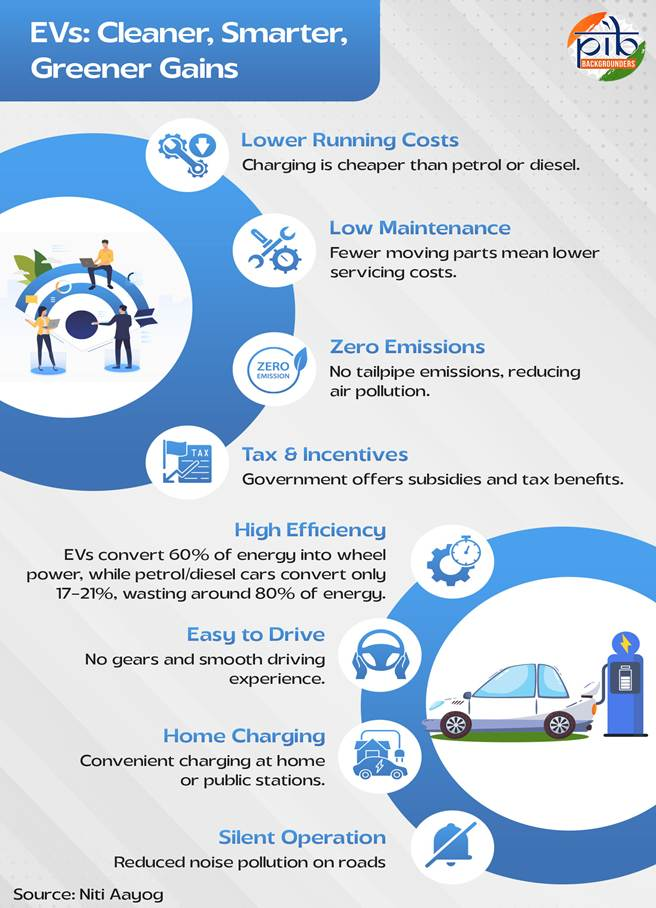
Government Initiatives
- National Electric Mobility Mission Plan (2020) and FAME-I: NEMMP was brought into effect to accelerate the adoption and production of electric vehicles (EVs).
- As part of this mission, the FAME India Scheme (Faster Adoption and Manufacturing of Hybrid and Electric Vehicles) was implemented from 2015 to 2019 to encourage the adoption of electric and hybrid vehicles.
- FAME II (Faster Adoption and Manufacturing of Electric Vehicles) — Phase II: Launched in 2019, the scheme focuses on increasing EV adoption, expanding the e-bus network, and strengthening the charging infrastructure.
- Production Linked Incentive (PLI) Scheme for Automobile and Auto Component Industry in India (PLI-Auto): Launched in 2021, the scheme aims to boost domestic manufacturing of Advanced Automotive Technologies (AAT).
- Major players like Tata Motors and Mahindra & Mahindra have stepped up with significant EV production investments.
- A key mandate is that companies must ensure at least 50% domestic value addition (DVA) to qualify for incentives.
- Scheme for Promotion of Manufacturing of Electric Passenger Cars in India 2024 (SPMEPCI): To draw global automakers to invest, the scheme grants approved applicants a five-year window to import Completely Built-in Units (CBUs) of electric four-wheelers (e-4W) valued at a minimum CIF (Cost, Insurance, and Freight) of USD 35,000 at a significantly reduced customs duty of 15%.
- India Electric Mobility Index (IEMI): NITI Aayog unveiled the India Electric Mobility Index (IEMI) in 2025. It is designed to track, measure, and compare how States and Union Territories are progressing on their electric mobility ambitions.
- Based on these results, regions are ranked as frontrunners with thriving ecosystems; Delhi, Maharashtra, and Chandigarh are leading as ‘Frontrunners’ in the recent IEMI score.
- PM e-Bus Sewa-Payment Security Mechanism (PSM) Scheme: It was notified in 2024, aims to support deployment of more than 38,000 electric buses.
- The objective of the scheme is to provide payment security to e-bus operators in case of default by Public Transport Authorities (PTAs).
Source: TH
Previous article
Building Resilient Supply Chains for India’s Economic Security
Next article
News In Short 30-03-2026
